Author Archives: Margriet Ruurs

Find a Poem!

From my book: The Power of Poems, Maupin House

Just as you can find things that become treasures, you can find words that, put together, make a poem. 

Here is a piece of (prose) writing:
“When I was little, Grandma’s button box was my favorite toy.
I would sit on the floor by Grandma’s chair and she would bring me the button box. Gently, she’d bend down and put it by my feet on the carpet.
Slowly, I’d lift the lid and stare at the treasure—glittering, shim- mering jewels they were.  Shiny black eyes, golden coins and sparkling diamonds off princesses’ dresses.
Then I’d tilt the box, slowly, with both hands until the buttons poured out onto the carpet.  I’d shift them with my hands, let them run through my fingers in a cascade of colors.  I’d make piles and bulldoze them around the carpet.  I felt the buttons. They felt good.”
Now I am going to pick words from this piece of writing and put them into a poem.  I will underline the words I choose:
“When I   was         little Grandma’s button box was my favorite toy.
I would sit on the floor by Grandma’s chair and she would bring me the button box.  Gently, she’d bend down and put it by my feet on the carpet.
Slowly, I’d lift the lid and stare at the treasure—glittering, shim- mering jewels they were.  Shiny black eyes, golden coins and sparkling diamonds off princesses’ dresses.
Then I’d tilt the box, slowly, with both               handsuntil the buttons poured out onto the carpet.  I’d shift them with my hands, let them run through my fingers in a cascade of colors.  I’d make piles and bulldoze them around the carpet.  I felt the buttons. They felt             good
Now I put these underlined words into a poem.  Look:
Grandma
I was little
Gently
her eyes sparkled
Both hands in my hands Grandma felt good.
I found a poem in a piece of prose!
Use any piece of your own writing for this activity. Find words and arrange them until you have found a poem.

Feature Movie: Library of the Early Mind

This documentary film explores children’s literature! Hooray for the creators, and those authors and illustrators interviewed.
OK, it’s very much American. Too bad they did not include some Canadian, or more international authors of children’s literature to give the study a broader scope.
Authors like Anthony Brown or Dick Bruna whose books are widely read in North America could have added a more worldly perspective.
However, this is an admirable production.

The accompanying website states that:

“Library of the Early Mind” is an exploration of the art and impact of children’s literature on our kids, our culture, and ourselves.
From the first stories we hear told to us to those childhood heroes that stay with us a lifetime, the impact on our culture runs deeper than what we might expect. “No one suspects the children’s writer,” says author and illustrator Mo Willems, a former ‘Sesame Street’ writer.
The film features nearly 40 prominent authors and illustrators talking about their work, its genesis and its impact. The number of books in print by the authors in ‘Library of the Early Mind’ exceeds 240 million.


It can be rented online to view directly on your computer, or you can purchase the DVD via the website. Check also to see if it is available in your local library.

http://libraryoftheearlymind.com/

Free Fall Writing

Today, take a sheet of paper and a pen to a comfortable spot: the table, your desk, a lawn chair, anywhere.

Then spend FIVE minutes writing free fall.
This means ANYTHING that comes up in your head. Just write for the sake of writing. Don’t try to think of a character, or a setting, or a description. Just write what comes to mind. Even if it is “I don’t know what the heck I’m writing…”

Free fall writing helps to clear your mind, helps to bring new ideas to light. It will make writing easier than when you always try to write with a clear idea in mind. It is even used as therapy. Google ‘free fall writing’ and you will find many websites and books devoted to the topic.

Try it.
If you like it, do it again tomorrow. Just five minutes.
After a few days, make it ten minutes. Pretty soon, your free fall writing might take a shape, show you a pattern. But don’t look for it soon.
Just write. Anything that comes to mind, without taking your pen off the paper!

Rhyme for a Reason

Read several books of great poems for kids:
• any title by Jack Prelutsky
• Owl Moon by Jane Yolen
• a Dr. Seuss book. Look up poetry books by Bruce Lansky, David Greenberg, Kenn Nesbitt (http://www.poetry4kids.com/)

• Read poetry books by Sheree Fitch and Loris Lesynski!!

• Read The Party and Two by Two, by Barbara Reid!

Now write a poem about a boy who did not do his homework.
Make up wild and funny excuses.
Use rhyme.
aa, bb.
Or a, b, a, b.

Yak-a-dee-yak

Use dialogue to create a believable character.
An adult sounds different from a four year old. A teen speaks different from a senior. And a trucker may sound different from a lady selling yarns. Select one of the following dialogue exercises, or do them all!

• Write a page of dialogue between a man working in the hardware store and an elderly lady who comes in looking for a tool.

• Write a page of dialogue between a pilot and air traffic control. Make it exciting.

• Write a page of dialogue between six year old Anna and her friend Michael. They are in the backyard. Show me, through their dialogue, what is happening.

Which children’s books have great dialogue? Read a Clementine book, and a book by Wendy Maas.

Paint Pictures

Several of my picturebooks won children’s choice awards selected by blind kids. That helped me enormously to realize that text has to work without art. As writers we have to paint pictures in the reader’s head with words.

Describe an object. Pick a flower, a puppy, a doll, the house across the street, a pine cone, anything. Describe it in detail for yourself on paper. Note its color, shape, size, texture. Now feel it. Describe how it feels. Or listen to any sounds and add them to your description.

Did you write half a page, a full page of description?
Now try to sum this all up by painting a picture of it. What does it compare to? Use a few poetic words instead of the long tedious paragraph.

In my book Emma’s Eggs I did not describe the chick yellow, round, fluffy, soft, etc. But after making this list I compared her and called her “a dandelion chick”. Does such a comparison work for your description?

Show me what it FEELS like.

Show, don’t tell. Here’s a writing activity to help you do that in a children’s story:

• Don’t tell me that Nathan is angry. Show me.

• Don’t say “Madeleine is sad.” Show me.

• Justin is supposed to be sleeping but he is afraid. Show me why and how he feels.

All the Write Moves…

Having just spent an intense week at the Oregon Coast Children’s Book Writers’ Workshop (http://www.occbww.com/), I decided to write some posts aimed at helping (beginning) writers. Most of my blog has been aimed at fellow booklovers and reading. However, many of you might also enjoy doing some writing activities.

So, I will aim to put a new writing activity on this blog each day for the next month or so. Just a short one. Something aimed at helping you to write each day for the sake of practise. We’ll look at description, voice, tense, dialogue and more. See how this fits into your day. Write for 5 minutes, if that’s all you have. Or expand my short activity into an hour of writing for you. Do it as a stand-alone exercise or fit it into a piece you already have… Just write.

So, for today, here we go.
The golden rule we’ve all heard about: SHOW, don’t tell.
Take me for a walk along the harbour. SHOW me what it looks like. Be sure to include the smells, sounds and feels of a harbour front on a… sunny day, or blustery day.

The Great Kapok Tree: A Tale of the Amazon Rain Forest by Lynne Cherry

The Great Kapok Tree: A Tale of the Amazon Rain Forest by Lynne Cherry

The rain forest is full of amazing animals, trees, vines and flowers. But one day a man enters the forest and the animals hold their breath. He is told to cut down the great kapok tree. The man tires and naps. While he sleeps the creatures take turns whispering in his ear what the tree means to each of them. When he wakes up, he gathers his axe and leaves. The forest can breath again.

This book – which looks at what the Kapok tree means to the creatures that live in it, and what rain forests mean to the world’s ecology – was at the forefront of the ecological movement and continues to resonate profoundly with children everywhere.

Beautifully written, with a strong message, this book can be enjoyed as a picture book and used in classrooms on many different levels.

Paperback, 40 pages, Houghton Mifflin Harcourt ISBN
0152026142 (ISBN13: 9780152026141)

Lesson Plan: http://www.teachervision.fen.com/skill-builder/lesson-plan/48709.html
http://www.homeschoolshare.com/great_kapok_tree.php
http://www.scholastic.com/teachers/lesson-plan/great-kapok-tree-extension-activities

Radical Reflections: Passionate Opinions on Teaching, Learning, and Living – by Mem Fox

Radical Reflections: Passionate Opinions on Teaching, Learning, and Living  by Mem Fox

Mem Fox, internationally acclaimed children’s book writer and educator offers insights into the learning process, language education, and the pleasure, growth, and power that reading and writing can bring.
Some of her most well known titles include Possum Magic and Koala Lou, I Do Love You.
But this title is fabulous reading for any educator, including homeschooling parents. She explains how no child will ever get passionate about filling in the blanks, but how to turn anyone into an avid reader.

At the same time I should mention Mem’s book specifically at parents:

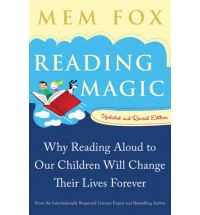
Reading Magic is a great guide to reading with children, now in a new and revised edition. Fox reveals the incredible emotional and intellectual impact reading aloud to children has on their ability to learn to read. With passion and humor, Fox speaks of when, where, and why to read aloud and demonstrates how to read aloud to best effect and get the most out of a read-aloud session. She discusses the three secrets of reading, offers guidance on defining and choosing good books, and–for this new edition–includes two new chapters on boy readers and phonics, a foreword, and a list of “Twenty Books That Children Love.” Filled with practical advice, activities, and inspiring true read-aloud miracles, this book is a turn-to classic for educators and parents.

I have often used these books as gifts for educators or new parents. Hope you love them.